My Child Says, “I Don’t Want to Go to School.” What Should I Do?
My Child Says, “I Don’t Want to Go to School.” What Should I Do?
When I was in kindergarten, my neighbor and friend Jennifer cried at drop-off every day for the first few weeks.
Every. Single. Day.
I remember watching her and thinking, “Why is Jennifer always sad about coming to school? School is fun!”
What I did not understand at five years old was that every child handles change and transitions differently. I felt ready for school. Jennifer needed more time.
As the days passed, she learned that school was a safe place. She made friends. She had fun. Most importantly, she learned that her mom always came back.
Then the crying stopped.
Those difficult mornings might feel endless to a parent standing at the classroom door. Watching your child cry and walking away is hard. It does not mean school is the wrong place for your child. It often means your child is still learning how to feel safe in a new place.
The tears will not last forever. The fear will ease. The routine will become familiar.
Your child does not feel comfortable at school yet.
Remember the magic word: YET.
Why Children Say, “I Don’t Want to Go”
A young child might not have the words to explain what feels wrong.
“I don’t want to go to school” might mean:
“I am tired.”
“I miss you.”
“I do not know what will happen today.”
“I am worried about making a mistake.”
“I do not know how to join the other children.”
“The classroom feels loud.”
“I had a problem with another child.”
“I am still getting used to my teacher.”
Try to learn what is behind the statement before offering a solution.
Stay Calm
Your reaction affects your child’s reaction.
If you look frightened or begin asking anxious questions, your child might believe there is a reason to fear school. Keep your voice calm and your response simple.
You might say:
“I hear that you do not want to go today. What part of school feels hard?”
Listen without interrupting. Avoid immediately saying, “There is nothing to worry about.” The worry feels real to your child, even when the situation is safe.
Accept the Feeling and Keep the Expectation
You do not need to argue with your child’s feelings. You also do not need to make school optional.
Try saying:
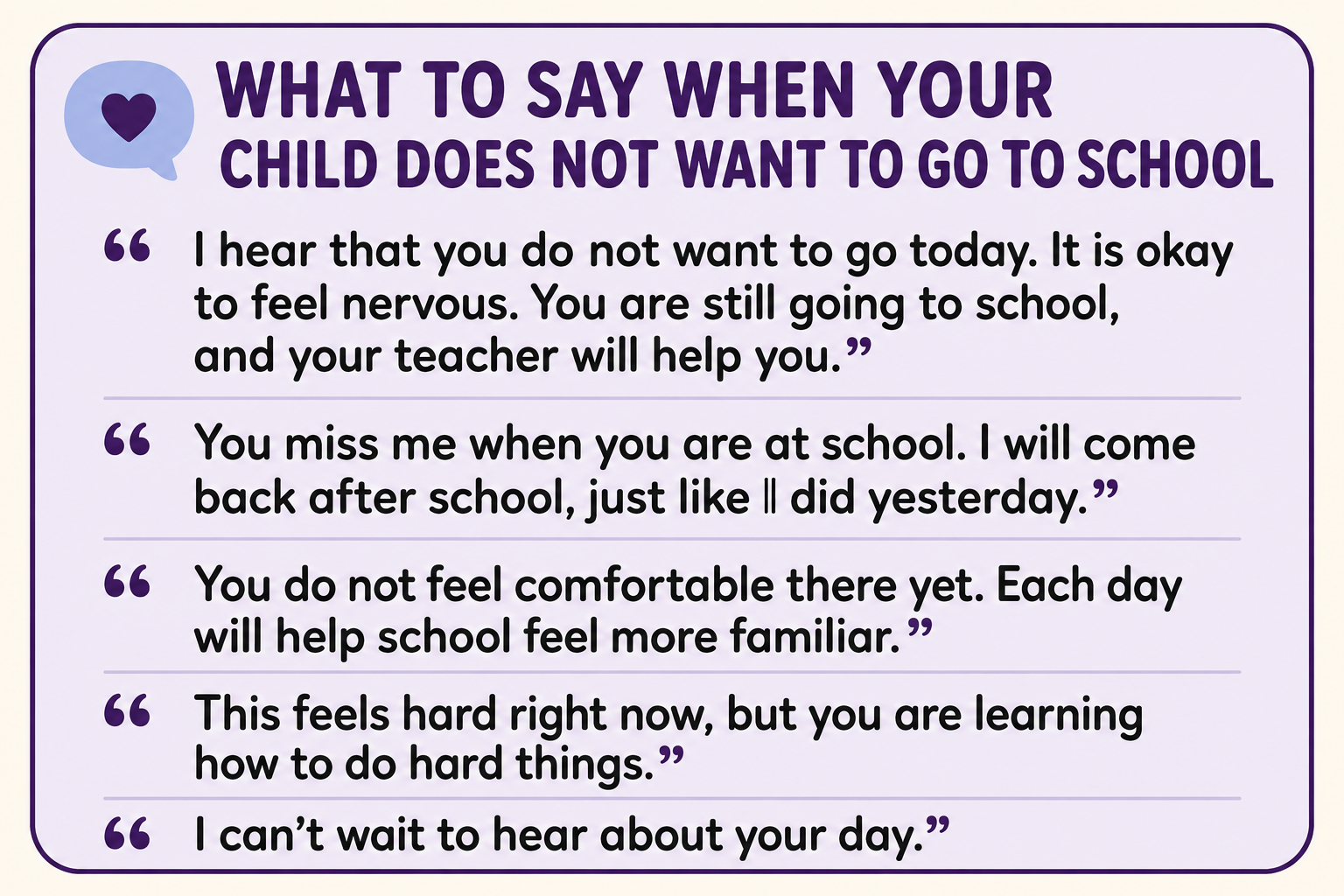
“It is okay to feel nervous. You are still going to school, and your teacher will help you.”
“You miss me when you are at school. I will come back after school, just like I did yesterday.”
“You do not feel comfortable there yet. Each day will help it feel more familiar.”
This response offers empathy, reassurance, and a clear boundary.
Ask Specific Questions
“Why don’t you want to go?” might feel too big for a young child to answer.
Ask smaller questions:
“Is the hardest part saying goodbye?”
“Does something feel hard in the classroom?”
“Are you worried about playing with the other children?”
“Did something happen yesterday?”
“Is there a part of the day you do not like?”
Specific questions help children identify what is bothering them.
Keep the Morning Routine Predictable
A familiar routine helps children know what comes next.
Try to follow the same order each morning:
Get dressed.
Eat breakfast.
Brush teeth.
Pack the backpack.
Leave for school.
Avoid long negotiations. Spending 20 minutes discussing whether your child wants to go often increases anxiety.
Focus on the next small step.
“First, we are getting dressed.”
“Next, we are eating breakfast.”
“Your job is to walk through the classroom door.”
Keep Goodbyes Short
When your child cries, your natural instinct might be to stay longer, offer more hugs, or keep explaining why school will be fun. Prolonging the goodbye often makes the separation harder.
Create a short, predictable routine. Give your child a hug, share one reassuring sentence, and leave calmly.
You might say:
“I love you. You are safe. Your teacher will take care of you. I can’t wait to hear about your day.”
Do not sneak away. Say goodbye clearly so your child learns to trust that you will leave and return when promised.
Your child might cry when you walk away. This does not mean you are doing something wrong.
Teachers are trained to comfort children, help them manage big feelings, and guide them toward an engaging activity. A teacher might invite your child to build with blocks, help with a classroom job, look at a favorite book, or join another child at play.
Many children stop crying shortly after their parents leave. A short, confident goodbye gives the teacher space to begin building a trusting relationship with your child.
Work With the Teacher
Tell the teacher what your child has been saying. Ask how long the crying lasts and what happens afterward.
You might learn that your child cries for two minutes and then happily plays with blocks for the rest of the morning.
You might also learn about a specific problem that needs attention.
Parents and teachers should share information and look for patterns together. Let the teacher know about changes at home, poor sleep, fears, or anything else that might affect your child’s morning.
Use Growth Mindset Language
Starting school involves many new skills. Children need practice separating from parents, following routines, asking for help, and joining a group.
Growth mindset language reminds children that difficult feelings change with time and practice.
Try saying:
“This feels hard right now.”
“You are learning how to feel comfortable at school.”
“You were nervous yesterday, and you still walked into the classroom.”
“You do not know everyone yet.”
“You have not found your favorite activity yet.”
“You are getting braver each day.”
Praise the effort your child shows, even when tears are present.
“I saw you hug me goodbye and walk inside, even though you felt nervous. That took courage.”
Avoid Promising a Perfect Day
Parents sometimes try to offer reassurance by saying:
“You are going to have the best day ever!”
What happens if your child does not have the best day ever?
A more helpful message is:
“Some parts of the day might feel easy, and some parts might feel hard. Your teacher is there to help you.”
This prepares children for normal challenges without making school sound scary.
Look for Small Signs of Progress
Progress does not always mean your child suddenly runs into school smiling.
Progress might look like:
Crying for five minutes instead of fifteen.
Walking into the classroom while holding the teacher’s hand.
Talking about one enjoyable activity.
Remembering another child’s name.
Separating without needing an extra goodbye.
Notice and celebrate these small steps.
“You were sad this morning, but you still went inside. You are learning how to handle a hard goodbye.”
Look for Patterns
Pay attention to when the school resistance happens.
Does it happen after poor sleep?
Does it happen on a certain day?
Is your child worried about a specific activity?
Did something change at home or school?
Does your child complain of headaches or stomachaches?
Patterns help parents and teachers understand whether the child needs more adjustment time or additional support.
When to Ask for More Help
Some school resistance is a normal part of adjusting. Speak with the teacher, school counselor, or pediatrician if the fear continues, becomes stronger, causes frequent physical symptoms, disrupts sleep, or affects daily life.
Take It One Day at a Time
A child crying at drop-off is hard for a parent to witness. It might leave you questioning whether you did the right thing by walking away.
Remember Jennifer.
She needed time to learn that school was safe, friends were waiting, fun was possible, and her mom would always return.
Your child might need time too.
Acknowledge the feeling. Keep the routine. Work with the teacher. Offer reassurance. Notice each small step forward.
Your child might not feel ready yet.
But yet means there is room to grow.


